
No other route in Nepal changes as much under your feet as the Annapurna Circuit Trek does. You start among rice terraces and waterfalls, climb through pine and rhododendron forest, cross a glaciated 5,416 metre pass, and come down the other side into a landscape that looks more like Tibet than Nepal. It’s the closest thing to an ‘everything, once’ trek the country offers, which is exactly why it has stayed one of Nepal’s classic treks for decades.
In this article
What the route actually covers
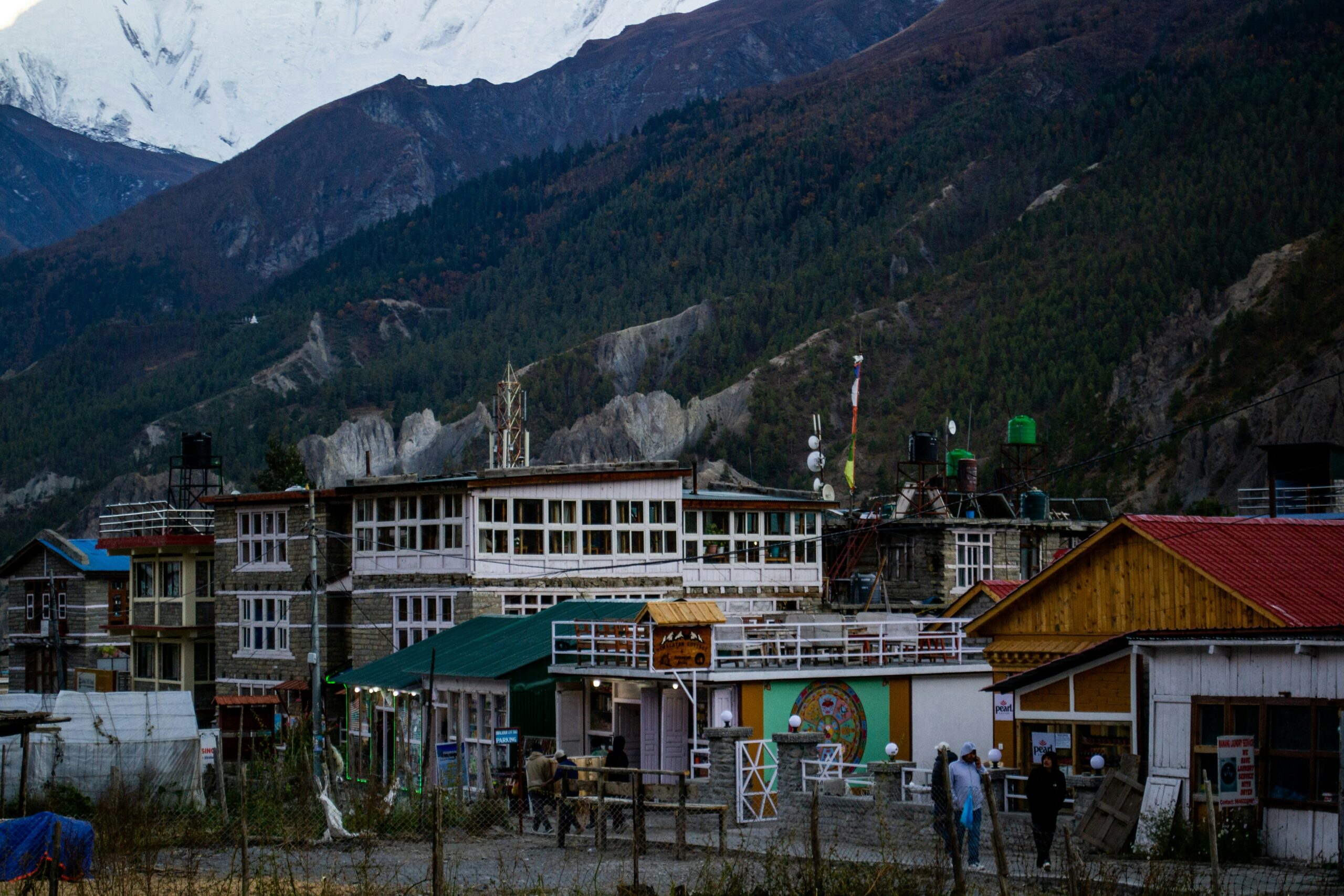
The classic circuit runs anticlockwise around the Annapurna massif. Our version starts with a long drive to Dharapani in the Marsyangdi valley, climbs through Chame, Upper Pisang and the high village of Ngawal to Manang, crosses Thorong La to Muktinath, then drops down the Kali Gandaki by shared jeep to the hot springs at Tatopani before finishing over Ghorepani and Poon Hill to Pokhara. Along the way you pass through at least four distinct climate zones: subtropical farmland below 2,000 m, temperate forest up to around 3,000 m, high alpine terrain approaching Thorong La, and the dry, wind-scoured Mustang side on the descent. We take the upper trail through Ngawal rather than the valley floor, which adds height gently and gives better views of Annapurna II and III on the way to Manang. By the time you reach Manang the forest has given way almost entirely to high alpine scrub and rock.
The route, day by day
- Day 1: Arrive in Kathmandu (1,400 m), transfer to the hotel and meet your guide.
- Day 2: Drive to Dharapani (1,860 m), 10 to 12 hours, the last three to four on a rough dirt road.
- Day 3: Trek to Chame (2,670 m), 5 to 6 hours.
- Day 4: Trek to Upper Pisang (3,300 m), 6 to 7 hours.
- Day 5: Trek to Ngawal (3,660 m) on the high trail, 4 to 5 hours.
- Day 6: Trek to Manang (3,540 m) via Bhraka, 3 to 4 hours.
- Day 7: Acclimatisation day in Manang, with a walk up to Gangapurna Lake.
- Day 8: Trek to Yak Kharka (4,050 m), 4 to 5 hours.
- Day 9: Trek to Thorong Phedi (4,525 m), 4 to 5 hours.
- Day 10: Cross Thorong La (5,416 m) before dawn and descend to Muktinath (3,760 m), 8 to 9 hours.
- Day 11: Shared jeep or bus down the Kali Gandaki via Jomsom to Tatopani (1,190 m), 6 to 7 hours.
- Day 12: Rest day at the Tatopani hot springs.
- Day 13: Trek to Ghorepani (2,840 m), 7 to 8 hours.
- Day 14: Sunrise on Poon Hill (3,210 m), trek down to Birethanti and drive to Pokhara.
- Day 15: Tourist bus back to Kathmandu, 7 to 9 hours, and a farewell dinner.
- Day 16: Departure.
Thorong La: the number everyone asks about
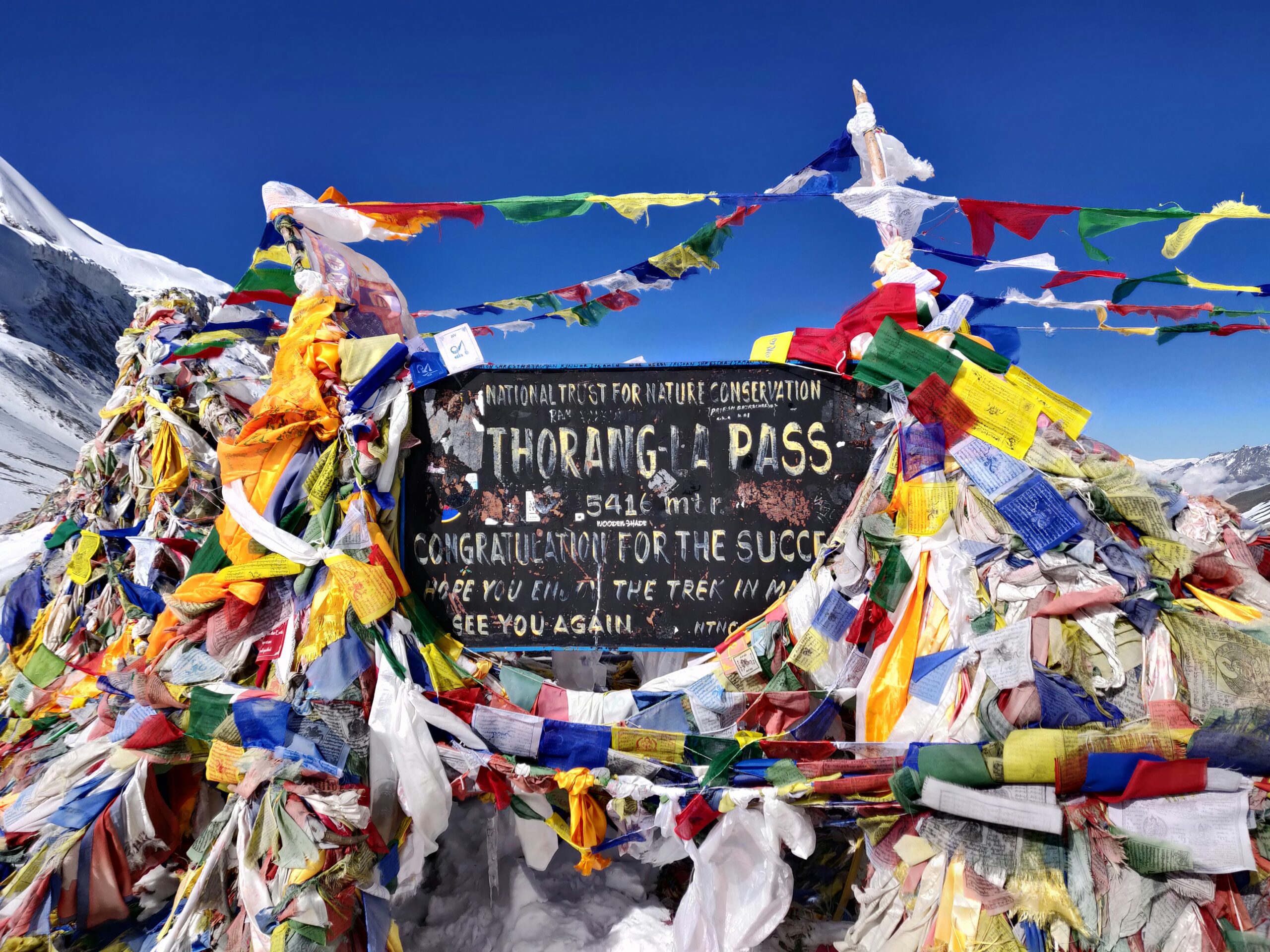
At 5,416 metres, Thorong La is the highest point on the circuit and the reason this route needs real acclimatisation planning, not just fitness. The approach from Manang spends several days building altitude gradually, with a rest day in Manang before Yak Kharka and Thorong Phedi. The pass itself is crossed in a single long day starting well before dawn to beat the afternoon wind, which can be strong enough to make the final approach genuinely unpleasant if you start late. The payoff on the far side is Muktinath, a pilgrimage site sacred to both Hindus and Buddhists, sitting in the dry Mustang landscape that feels like a different country entirely. If altitude is a new concern for you, our guide to altitude sickness covers the same symptoms and the same descent-first approach we use here, even though it’s written around the Everest route.
Best time of year
Autumn (late September to November) and spring (March to May) remain the two reliable windows, with stable weather and clear mountain views on both sides of the pass. Winter is possible on the lower sections but Thorong La itself can close after heavy snowfall, and the pass crossing becomes unpredictable; we’ll tell you honestly if a winter booking looks risky rather than taking the deposit anyway. Monsoon (June to August) brings leeches and washed-out trails lower down and is best avoided for this particular route, unlike Upper Mustang on the far side of the pass, which stays largely dry through the same months.
What’s included, and what isn’t
Our standard price covers your Annapurna Conservation Area Permit and TIMS card, a government-licensed guide, one porter for every two trekkers, three meals a day on the trail for twelve nights, private vehicle transfers to Dharapani and from Birethanti to Pokhara, the shared jeep or bus from Muktinath to Tatopani, the tourist bus back to Kathmandu, two nights in a three-star Kathmandu hotel and one in Pokhara with breakfast, a farewell dinner, and the loan of a down jacket and sleeping bag. It does not cover your international flights, Nepal entry visa, travel insurance with evacuation cover, bottled drinks, lunches and dinners in Kathmandu and Pokhara, tips, or the optional comfort-tier upgrades. The full line-by-line list, along with the group-size ladder, is on the Annapurna Circuit Trek page.
How long it takes and what it costs
Our standard itinerary runs 16 days from landing in Kathmandu to flying home. If you want to add Tilicho Lake, one of the highest lakes of its size in the world, our Tilicho Lake and Thorong La Trek builds it into the route. The price is per person and depends on how many of you travel together: 1,150 USD each for two or three people, 1,380 USD for a solo trekker, 1,080 USD each for four to six, and 1,010 USD each for seven or more, with permits, guide, porters, full board on the trail and your hotels all inside that figure.
Training beforehand
You don’t need technical climbing fitness, but you do need to be comfortable walking five to seven hours a day, several days in a row, with a day pack. In the months before you travel, regular hill walking, stair climbing or a stepper machine, and a few longer back-to-back walking days are the most useful preparation, closer to marathon training than to gym strength work. Trekkers who arrive having never walked more than two hours continuously tend to struggle more with the daily grind than with the altitude itself.
Annapurna Circuit vs Annapurna Base Camp
People often confuse these two. Annapurna Base Camp is a there-and-back trip into the Sanctuary, topping out at 4,130 m with a single high point; the Circuit goes right around the massif, crosses a much higher pass, and runs longer. If you want depth and variety over 16 days, the Circuit is the better fit; if you want a shorter, lower-altitude trip, our Annapurna Base Camp itinerary guide and its trip page lay out the alternative. We also cover the broader question in Everest Base Camp vs Annapurna Base Camp if you’re weighing up a third option entirely.
Permits you’ll need
The route requires the Annapurna Conservation Area Permit and a TIMS card, both arranged by our office and included in the trip price. For what each permit actually covers and why, see our full Nepal trekking permits guide.
Common questions
Do I need previous trekking experience? Not strictly, but this isn’t the easiest route to start on either. If it’s your first multi-day trek, build up with something shorter first; see our best treks for first-timers.
Can I shorten it? Yes. Our itinerary already drives the lower valley to Dharapani, and the Tatopani rest day or the Poon Hill finish can be dropped if you’re short on time, cutting two or three days without skipping the pass itself.
What if I can’t cross the pass? Your guide makes that call on the day based on weather and how the group is acclimatising. If Thorong La isn’t safe to cross, the alternative is retracing your steps rather than pushing on regardless.
Is it for you?
This is a strenuous trek by length and altitude, better suited to trekkers who’ve already done at least one multi-day route, or who are prepared to train for one. If you want something shorter to start with, our roundup of the best treks in Nepal for first-timers covers gentler options. For what day-to-day life on the trail actually looks like, read teahouse trekking in Nepal: what to actually expect, and for a wider sense of how we grade routes, see Nepal trekking difficulty levels explained.
Booking
Every departure we run is private, arranged around your own dates rather than a fixed group calendar; see our full comparison of private vs group trekking if you’re weighing that up. Read how booking a private trek with us works, or get in touch with your travel dates and we’ll confirm guide availability for the season you want.