
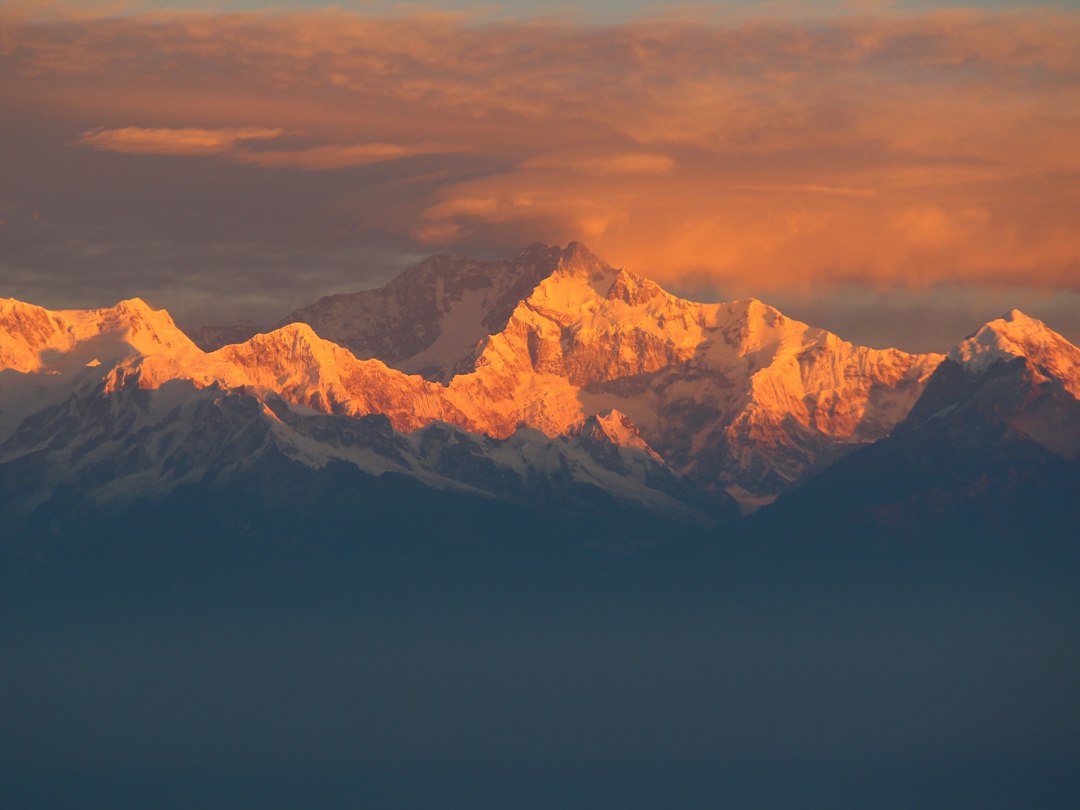
Kanchenjunga is the third highest mountain on earth at 8,586 metres, and the trek around it is one of the longest and least crowded in Nepal. The Kanchenjunga Base Camp Trek reaches both of its base camps, Pangpema in the north and Oktang in the south, on a 22 day route through the far east of the country where almost nobody else is walking.
In this article
Why so few people do this one
Three things keep the numbers down here: the distance from Kathmandu, the restricted area rules, and the length of the trek itself. Getting to the trailhead means a flight to Bhadrapur on the southeastern plains, then a long drive north into the hills, before the walking even starts. Add three weeks away and a permit that until recently needed two people to apply for, and most trekkers choose Everest or Annapurna instead. What that leaves is a trail where you see local traders and the occasional other small group rather than a queue at the viewpoint.
The route and the two base camps
The trek follows the Tamor and then the Ghunsa Khola upstream from Sukethum through forest and small Tibetan influenced villages to Ghunsa, the last proper village before the high country. From there it climbs to Khambachen and Lhonak before a day trip up to Pangpema, the north base camp at 5,143 metres, with the north face of Kanchenjunga directly overhead. The route then drops back to Ghunsa and crosses three passes in a single long day, Sinion La, Mirgin La and Sinelapche Bhanjyang at 4,785 metres, to reach the southern side at Tseram. From there a second day trip reaches Oktang, the south base camp viewpoint at 4,730 metres, below the south face and its three main summits, before the trek descends through forest and terraced villages back to the road at Hellok.
The route, day by day
- Day 1: Arrive in Kathmandu (1,400 m).
- Day 2: Fly to Bhadrapur (91 m), drive to Taplejung or Phidim (1,820 m), 5 to 9 hours.
- Day 3: Spare day in Taplejung, used only if the flight or the road ran late.
- Day 4: Drive to Sukethum (1,585 m), 4 to 5 hours.
- Day 5: Trek to Amjilosa (2,396 m), 6 to 7 hours.
- Day 6: Trek to Gyabla (2,730 m), 4 to 5 hours.
- Day 7: Trek to Ghunsa (3,417 m), 4 to 5 hours.
- Day 8: Acclimatisation day in Ghunsa.
- Day 9: Trek to Khambachen (4,050 m), 4 to 5 hours.
- Day 10: Trek to Lhonak (4,780 m), 4 to 6 hours.
- Day 11: Pangpema, the north base camp (5,143 m), and back to Lhonak, 6 to 8 hours.
- Day 12: Trek back to Ghunsa (3,417 m) via Khambachen, 6 to 8 hours.
- Day 13: Trek to Selele (4,200 m), 3 to 5 hours.
- Day 14: Cross Sinion La, Mirgin La and Sinelapche Bhanjyang (4,785 m) to Tseram (3,870 m), 7 to 8 hours.
- Day 15: Trek to Ramche (4,580 m), 3 to 4 hours.
- Day 16: Oktang, the south base camp (4,730 m), and back to Tseram, 5 to 7 hours.
- Day 17: Trek to Tortong (2,995 m), 4 to 5 hours.
- Day 18: Trek to Yasang (2,144 m), 5 to 6 hours.
- Day 19: Trek to Hellok, drive to Taplejung (1,820 m).
- Day 20: Drive to Bhadrapur, fly to Kathmandu (1,400 m), farewell dinner.
- Day 21: Spare day in Kathmandu, used only if the return flight ran late.
- Day 22: Departure.
Altitude and acclimatisation
There is a built in acclimatisation day at Ghunsa (3,417 m) before the push higher, and the biggest single jump in sleeping altitude comes straight after it, from Khambachen (4,050 m) to Lhonak (4,780 m). A second, smaller jump comes later, from Ghunsa back up to Selele (4,200 m) and on to Ramche (4,580 m), though by then you will already have been as high as Pangpema. Two spare days are built into the plan, one at Taplejung and one in Kathmandu, mainly there to absorb a delayed flight to or from Bhadrapur, but your guide can use either of them, or add a rest day at Khambachen, if anyone in the group needs more time to adjust.
Permits, and the solo rule that changed
Kanchenjunga sits inside a restricted area, so a licensed guide is mandatory and the Restricted Area Permit, along with the Kanchenjunga Conservation Area Permit, is applied for through a registered agency rather than bought at the trailhead. Until March 2026 the restricted area permit was only issued to groups of two or more, which meant a solo traveller had to either find a trekking partner or pay for a notional second permit. Nepal’s Department of Immigration dropped that requirement, so a single trekker can now get the permit on their own, travelling with their guide. Our permits guide covers how this compares with the national park and conservation area fees used on other routes.
Best time to go
We only run this trek in autumn (September to November) and spring (March to May). The three passes between Selele and Tseram are the limiting factor: heavy winter snow can close them, and monsoon cloud removes most of the view you have come 22 days for, on top of a wetter trail at the lower altitudes.
Teahouses on this route
Below Ghunsa the lodges are ordinary teahouses, similar to what you would find on Annapurna or Everest side trails. From Khambachen upward, and at Selele, Tseram and Ramche, the facilities get simpler: a bed, a dining room with a stove, and not much else. There is no lodge competition up here the way there is in the Khumbu, so comfort is not really the point of this trip. If you want a sense of what a teahouse night generally involves before you commit to three weeks of them, our teahouse trekking guide is a good place to start.
Cost and what is included
The price is per person: 2,175 USD each for two or three travellers, 2,045 USD each for four to six, and 1,915 USD each for seven or more, or 2,610 USD for a solo traveller now that the restricted area permit allows it. That covers the Restricted Area Permit and Kanchenjunga Conservation Area Permit, a government licensed guide, porters, three nights in a three star Kathmandu hotel with breakfast, 18 nights of teahouse accommodation and full board on the trek, the domestic flights between Kathmandu and Bhadrapur, private jeep transfers, a farewell dinner, a kit bag and basic trekking gear, and a first aid kit with a daily oximeter check in the mountains. International airfare, your Nepal visa, travel insurance, drinks, and tips are not included. Full details are on the Kanchenjunga Base Camp Trek page.
How it compares to Everest and Manaslu
The Everest Base Camp Trek is shorter, needs no restricted area permit, and sees far more trekkers on the trail at any time of year. The Manaslu Circuit is the closer comparison: also a restricted area, also quiet, but it is a loop of around 15 days rather than an out and back to two separate base camps over 22. Kanchenjunga is the longer and more remote option of the two, with fewer villages, more basic lodges in the upper sections, and a bigger commitment of time.
Who it suits
We grade this one Very Strenuous, and the length is as much a factor as the altitude. It suits trekkers who have already done a multi week high altitude trek and know how their body handles consecutive long days above 4,000 metres. If this would be your first time at altitude, a shorter route is the better place to start. Our guide to Nepal trekking difficulty levels explains where a trek like this sits compared with the more commonly walked routes.
Booking
Restricted area permits take longer to process than an ordinary conservation area permit, so this is worth booking well ahead of your travel dates, whether you are going solo or with a group. See how booking a private trek with us works, or contact us to check dates and availability.