Geology Field Trek: Annapurna Sanctuary, Led by Nepali Geologists
- Duration
- 14 days
- Max altitude
- 4,200 m
- Difficulty
-
Moderate
Difficulty scale
- Easy Short walking days on good trails below about 3,000 m. Suitable for anyone in ordinary health, including families.
- Moderate 5 to 6 hours a day with some steep sections, reaching up to about 4,000 m. A reasonable level of fitness and a few weeks of preparation walking recommended.
- Strenuous 6 to 8 hours a day, high passes or altitudes above 5,000 m, and remote stretches. Good fitness, prior trekking experience and proper acclimatisation days are essential.
- Very strenuous Long days, multiple high passes or technical sections, sustained time above 5,000 m. For experienced, well-conditioned travellers only.
- Best season
- Autumn (Sep–Nov) · Spring (Mar–May)
- Group
- Private
- Per person, 2 travellers
- $1,550
A technical, field-based trek led by PhD geologists of Nepal, at the slow pace that field work needs. We keep walking days short and add field days at altitude for acclimatisation and study.
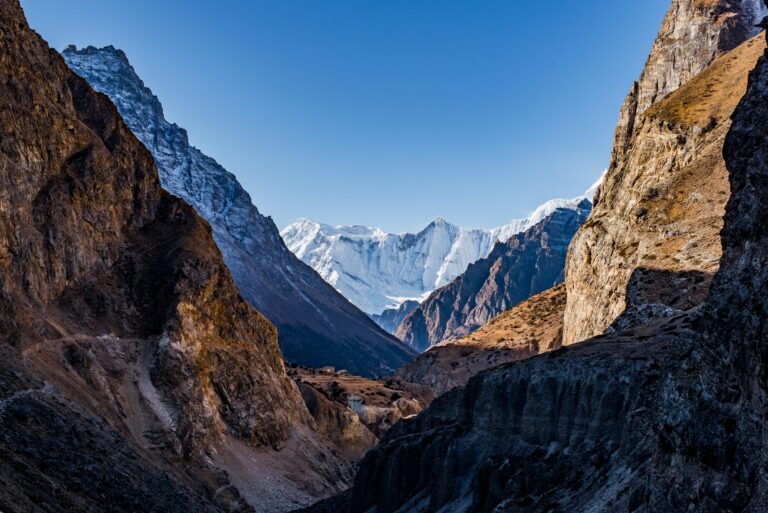
The Annapurna Sanctuary is a natural amphitheatre ringed by high peaks, and the route climbs through a full geological section. You start in the Lesser Himalaya near Pokhara, climb through metamorphic rocks into the high crystalline core, and reach a basin walled by the Tethyan sedimentary rocks of the Annapurna massif, the old Tethys sea floor lifted to over 8,000 m. Hot springs at Jhinu on the way down show how heat and fluid move through the mountain.
Choose a track when you book: Foundation for students and curious beginners, Field for graduates and working geologists, or Advanced for researchers who want structural measurement and current debates. Accommodation is basic by design, with no comfort upgrades.
Trip highlights
- Led by PhD geologists of Nepal, with beginner, field and advanced tracks
- A south to north section from Lesser Himalaya rocks into the high crystalline core
- The Annapurna Sanctuary, ringed by Tethyan sedimentary rocks of the old Tethys sea
- Glacial landforms and the dynamic basin around Annapurna Base Camp
- Hot springs at Jhinu Danda and the heat story of the range
The itinerary
-
Day 1: Arrive in Kathmandu 1,400 m Simple hotel Notincluded
Airport pickup and transfer to your hotel. Evening briefing with the geologist leaders on the route cross-section and the track each person has chosen.
-
Day 2: Fly to Pokhara 820 m Simple hotel B
A short flight to Pokhara and an afternoon field stop in the Lesser Himalaya around the Seti gorge and the Pokhara basin.
-
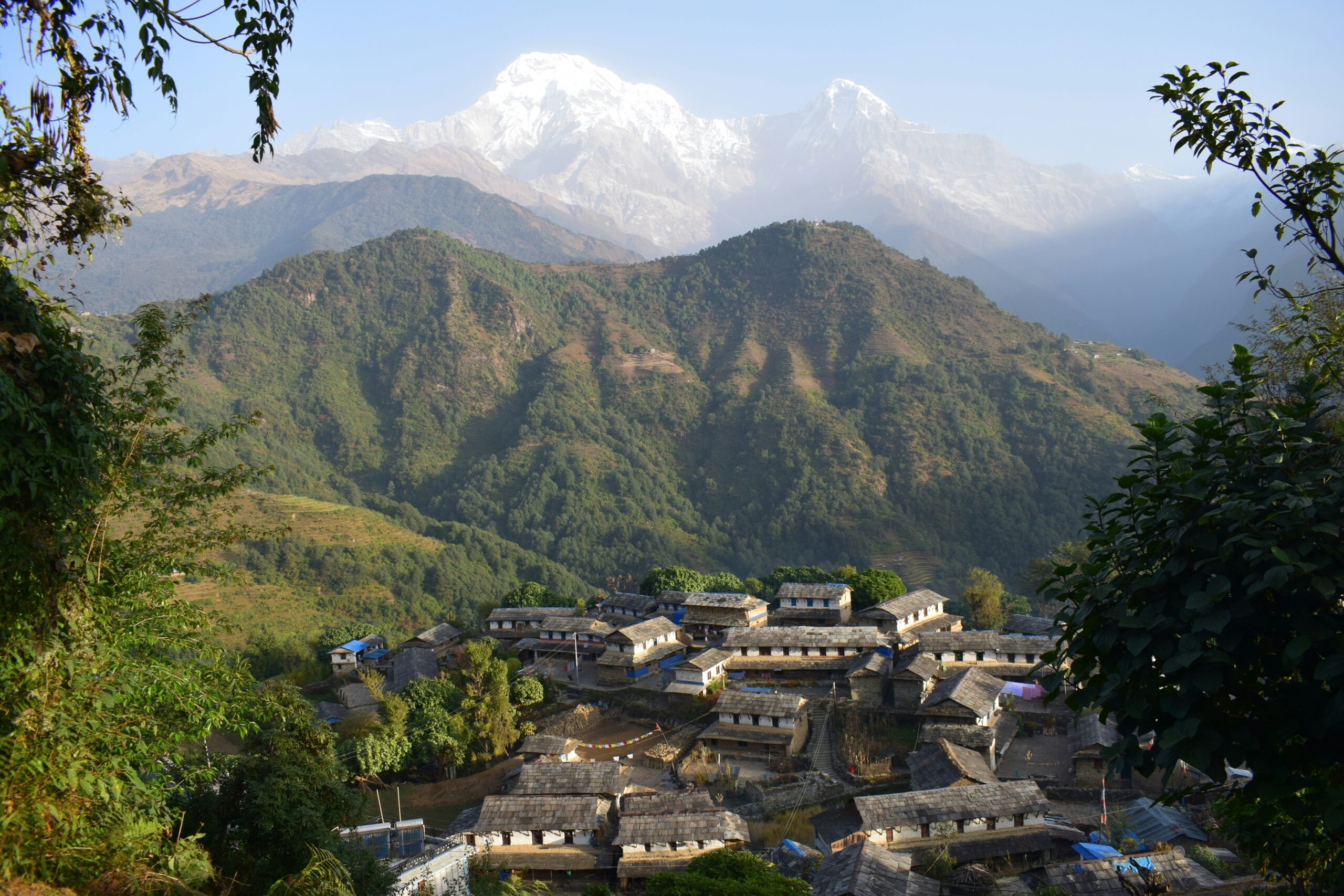
Day 3: Drive to Nayapul and walk to Ghandruk 1,940 m Teahouse B/L/D
A drive to the trailhead and a steady climb through Lesser Himalayan rocks to the village of Ghandruk, with the first views of the range.
-
Day 4: Ghandruk to Chhomrong 2,170 m Teahouse B/L/D
Cross valleys and ridges with road-cut and trail outcrops of schist and gneiss, and a talk on the Main Central Thrust and metamorphic grade.
-
Day 5: Chhomrong field day 2,300 m Teahouse B/L/D
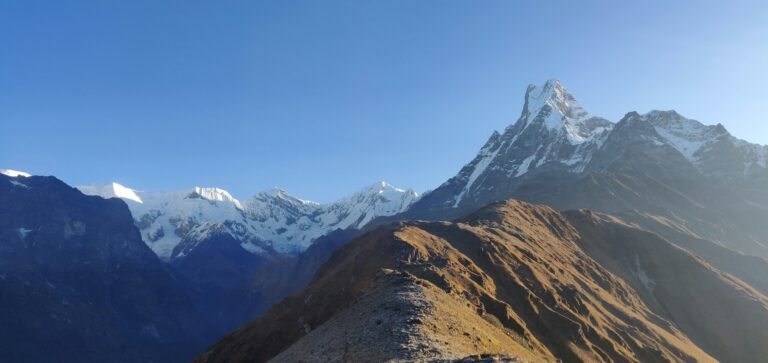
A slow day with views of Machhapuchhre and Annapurna South, studying the structure of the valley and sketching the cross-section.
-
Day 6: Chhomrong to Himalaya 2,920 m Teahouse B/L/D
The trail enters the Modi Khola gorge and climbs gradually, with outcrops of the high-grade rocks and a discussion of river incision.
-
Day 7: Himalaya to Machhapuchhre Base Camp 3,700 m Teahouse B/L/D
A short, high day into the Tethyan limestone walls, with avalanche tracks and glacial deposits to study.
-
Day 8: To Annapurna Base Camp 4,130 m Teahouse B/L/D
A short climb into the Sanctuary basin, with the amphitheatre of peaks and layered sedimentary rocks all around. Afternoon rest and lecture.
-
Day 9: Sanctuary field day 4,200 m Teahouse B/L/D
A slow field day in the Sanctuary on moraines and basin sediments, observing the dipping Tethyan limestone and glacial landforms. Advanced groups can measure structure in the lower walls.
-
Day 10: Back to Himalaya 2,920 m Teahouse B/L/D
A long descent retracing the section in reverse, with an evening discussion session.
-
Day 11: Himalaya to Jhinu Danda 1,780 m Teahouse B/L/D
Descend to Chhomrong and Jhinu Danda, finishing with the hot springs and a talk on heat flow and fluids in the range.
-
Day 12: Jhinu to Nayapul and Pokhara 820 m Simple hotel B/L
The last walk to Nayapul, then a drive to Pokhara and an evening workshop to compile the cross-section.
-
Day 13: Return to Kathmandu 1,400 m Simple hotel B
A flight or drive to Kathmandu, then an afternoon workshop on notes, sections and photographs.
-
Day 14: Departure 1,400 m B
Breakfast and a private transfer to the airport for your onward journey.
The climb, day by day
What's included
Included
- Included: Field leadership by PhD geologists of Nepal throughout
- Included: Daily geology briefings, outcrop stops and evening sessions
- Included: Geological map, route cross-section and a field notebook
- Included: Airport pickup and drop by private vehicle
- Included: Two nights in a simple hotel in Kathmandu and two in Pokhara with breakfast
- Included: Flight Kathmandu to Pokhara and the return to Kathmandu
- Included: Private vehicle to and from Nayapul
- Included: Teahouse lodging and three meals a day on the trek
- Included: ACAP entry permit and TIMS
- Included: Licensed English-speaking guide and porters for logistics
- Included: Entry fees, government taxes and our service charge
Not included
- Not included: International airfare and the Nepal entry visa
- Not included: Travel insurance covering trekking to 4,500 m
- Not included: Meals not listed in the itinerary and all drinks
- Not included: Personal field gear such as hand lens, compass clinometer and hammer (collecting rocks is not allowed in conservation areas)
- Not included: Comfort or luxury upgrades, which this expedition does not offer
- Not included: Tips for the guide, drivers and porters
- Not included: Anything not listed under what is included
Suitability & requirements
This is a technical, field-based trek. Choose your track (Foundation, Field or Advanced) when you book. Rock collecting is not allowed in conservation areas, so the work is observation, measurement, sketching and photography. The upper Sanctuary has avalanche risk in winter and spring, so dates are chosen with the guide. Accommodation is basic by design.
Led by a licensed guide
Every route is led by a government-licensed guide from our team. Licences are on record with us before departure, and you'll meet your guide once your trip is confirmed.
Guide language(s): English, Nepali
Walk together, pay less
Every trip is private, so the guide, permits and transfers cost the same however many walk. Sharing them is why the per-person price falls: arithmetic, not a sale.
| Group size | per person | You save each |
|---|---|---|
| 1 traveller | $1,950 | base rate |
| 2 to 3 travellers | $1,550 | $400 |
| 4 to 6 travellers | $1,420 | $530 |
| 7 or more | $1,350 | $600 |
Per person, including permits, park fees and taxes. Nothing is added at checkout.
What to expect, month by month
- Autumn (Sep–Nov)The most reliable trekking season: clear air, stable weather and cold nights, right after the monsoon clears.
- Spring (Mar–May)Warmer than autumn, with rhododendron forests in flower and slightly hazier mountain views as the season goes on.